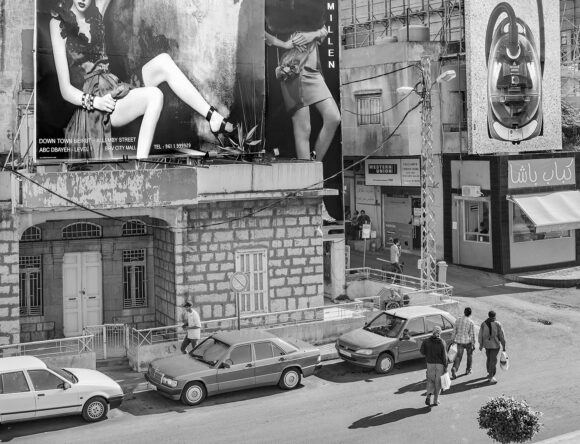
This work explores how globalized communication brings idealized images from one culture into contact with the realities of another. Between 2014 and 2020, I photographed Beirut, a city dominated by billboards. During those years, the city experienced a transformative construction boom followed by national economic collapse in 2019. I was motivated by a lack of visual history of Lebanon’s everyday landscape. In one sense, the advertisements and building projects serve as a visualized end energizing capitalist growth, and in another, they purport a mythologized Western ideal that is incongruous in the post-conflict city. The advertisements and pervasive neo-liberal capital represent our most recent form of colonialism. What is new and fascinating about this system is that it employs images as its most powerful tool. This under-documented place is now occupied by images of a different place and people.
German translation below ↓
Beirut/Big Ben, 2014
Johnnie Walker Post-War Advertisement. After 2006 Conflict, 2014
Chivas / Compressor, 2015
Picanto poolside, 2020
Dream Village, 2017
Takeover, 2020
Mobylette, 2019
Suna, 2021
Untitled (Stars), 2020
Ripple, 2017
Saifi Village, 2019
Time Indefinite, 2015
Showrooms, 2015
Render on Electronic Billboard, 2018
Fireplace, 2015
Washing walls, 2020
Plus Properties, 2020
Madmen, 2021
Signs after protests, 2020
Untitled (Dog), 2018
Untitled (Cat), 2016
80 kpm, 2014
Five Sonata Billboards, 2014
Bride, 2021
View From Hotel Window, 2016
Gift, 2014
Millen/Bissell, 2014
Next, 2018
Untitled (Shopper), 2015
Kate Winslet, 2016
omg, 2015
Tom Tailor, 2016
Free Netflix, 2020
Behind this panel, 2020
Diese Arbeit untersucht, wie globalisierte Kommunikation idealisierte Bilder einer Kultur mit den Realitäten einer anderen in Kontakt bringt. Zwischen 2014 und 2020 fotografierte ich Beirut, eine Stadt, die von Werbetafeln geprägt ist. In diesen Jahren erlebte die Stadt einen
transformativen Bauboom, auf den 2019 der nationale wirtschaftliche Zusammenbruch folgte. Mich motivierte das Fehlen einer visuellen Geschichte der alltäglichen Landschaft des Libanon. In gewisser Hinsicht dienen die Werbeanzeigen und Bauprojekte als visualisiertes Ziel, das das kapitalistische Wachstum antreibt, und in anderer Hinsicht vermitteln sie ein mythologisiertes westliches Ideal, das in der Stadt nach dem Konflikt fehl am Platz ist. Die Werbeanzeigen und das allgegenwärtige neoliberale Kapital stehen für unsere jüngste Form des Kolonialismus. Das Neue und Faszinierende an diesem System ist, dass es Bilder als sein mächtigstes Werkzeug einsetzt. Dieser unzureichend dokumentierte Ort wird nun
von Bildern eines anderen Ortes und anderer Menschen eingenommen.
Beirut/Big Ben, 2014
Johnnie Walker Post-War Advertisement. After 2006 Conflict, 2014
Chivas / Compressor, 2015
Picanto poolside, 2020
Dream Village, 2017
Takeover, 2020
Mobylette, 2019
Suna, 2021
Untitled (Stars), 2020
Ripple, 2017
Saifi Village, 2019
Time Indefinite, 2015
Showrooms, 2015
Render on Electronic Billboard, 2018
Fireplace, 2015
Washing walls, 2020
Plus Properties, 2020
Madmen, 2021
Signs after protests, 2020
Untitled (Dog), 2018
Untitled (Cat), 2016
80 kpm, 2014
Five Sonata Billboards, 2014
Bride, 2021
View From Hotel Window, 2016
Gift, 2014
Millen/Bissell, 2014
Next, 2018
Untitled (Shopper), 2015
Kate Winslet, 2016
omg, 2015
Tom Tailor, 2016
Free Netflix, 2020
Behind this panel, 2020
all images are Archival Fiber Inkjet Prints, printing sizes from 10 × 15,5 to 30 × 40 inches,
© Manal Abu-Shaheen, New York, 2026